Wednesday, February 20, 2013

Climate Change Awareness Taken a Notch Higher.


By Charles Ogallo

Climate change is widely recognized as the major environmental problem currently facing the globe. Scientists and Environmentalists alike have agreed over the reality of Climate Change.  

They have also recognized Climate Change as a global crisis expected to hit developing countries the hardest. Its effects; higher temperatures, changes in precipitation patterns, rising sea levels, and more frequent weather-related disasters—pose risks for agriculture, food, and water supplies.

At stake are recent gains in the fight against poverty, hunger and disease, and the lives and livelihoods of billions of people in developing countries.This is according to both the UNEP and World Bank reports.

However all these information have clearly been simplified in a graphic form by Infographics Climate Change , which is  featuring to be more informative and a must-visit site for anyone hoping to get in depth information about climate change.
Climate Change


Sunday, December 9, 2012

Time For Africa To Reap CDM Benefits.


By Charles Ogallo in Doha, Qatar. 


The time has come for Africa to reap the fruits of Clean Development Mechanism commonly known as CDM under the Kyoto Protocol, an international legally binding agreement.

Among new investment initiatives aimed at tackling climate change as well as reducing greenhouse gases  emissions globally , CDM has proved to be helpful in promoting sustainable development among communities facing the extremes of this global phenomenon especially in developing nations.

This follows an establishment of a loan scheme by United Nations Framework Convention on Climate Change UNFCCC to assist with project development in countries underrepresented in the CDM. The CDM loan scheme was officially launched on 18 April 2012, during the fourth Africa Carbon Forum in Addis Ababa, Ethiopia.

Addressing a group of African Radio Journalists at the UN Climate Change Conference in Doha Qatar, Mr Conor Barry an expert with the United Nations Framework Convention on Climate Change said the CDM loan scheme was introduced by  UNFCCC with an aim of financing CDM projects implementations and will be implemented in partnership with UNEP RISQ Center and UNOPS.  

Mr Barry announced that loan worth $3 million have already been approved and that 69% of applications for loans have come from projects in African countries, most (66%) of them were for small scale community friendly projects.

The types of projects include: EE household (lightning) (stoves), EE Service (water purification), Geothermal, Hydro, Landfill gas (Landfill flaring), Methane avoidance (domestic manure) (waste waster), Solar PV and Transport.

Host countries for funded projects include: Belize, Burkina Faso, Kenya, Madagascar, Malawi, Nigeria, Rwanda, Sudan, Uganda and United Republic of Tanzania.

These projects are Safe Water Access project in Rwanda, Cable Propelled Transit project in Nigeria, Water Purification project in Tanzania, Biogas production project in Sudan and Waste to energy production project in Kenya.
Africa has 14 percent in regional distribution which is the highest number of applications with Kenya having one one application for Waste handling and disposal project in Nairobi at a cost of US dollars 417, 500, Asia and Middle East 5 percent while Carribean has only one percent.

According to CDM executive Board annual report released a head of the COP18 held in Doha Qatar, these and other initiatives have sought to remove barriers to participation in CDM and have benefited from cooperation with stakeholder groups and partner agencies, under the banner of the Nairobi Framework.

UNFCCC SCALES UP CDM IN AFRICA.


By Charles Ogallo in Doha Qatar.


United Nations Framework Convention on Climate Change -UNFCCC has rolled out a revamped   outreach programs aimed at scaling up public awareness on Clean Development Mechanism, commonly known as CDM of the Kyoto Protocol in Africa.

Two projects currently rolled out in Africa and other least developing countries around the globe are among them Regional Collaboration Centers- RCC and Help-Desks, mainly to promote public awareness about CDM and show case benefits of CDM projects in climate change mitigations and promotion of sustainable developments. 

These initiatives come as the UN body’s reports indicate that Africa still lags far behind in number of projects being implemented globally under CDM, with only 2 percent of all registered projects to date.

According to experts, Clean Development Mechanism has far reaching benefits in reducing carbon emissions and other greenhouse gases as well as sustainable developments among communities affected by climate change.

Irini Roumboglou one of senior communication officers with UNFCCC told African Radio Journalists attending media training on CDM in Doha, Qatar that the first Regional Collaboration Center- refered as RCC has been launched in Lome, Togo.

It will involve capacity building – to train project developers as experts on chosen technologies/measures identified above in partnership with universities and colleges, give direct support to projects – identified several projects in the CDM cycle that are facing difficulties in validation/registration/monitoring/issuance process and assisting with UNFCCC requirements.

The RCCs will be also promote outreach and workshops programs – In collaboration with BOAD staff, technologies/measures identified to focus on new project development – throigh technology/measure-specific workshops with: Implemented projects e.g. Landfill in Cameroon, CFLs in Senegal, Cookstoves in Mali, Potential projects interested in these technologies/measures and technology providers that have already been involved in CDM projects.
It will further involves  DOEs interested to validate the projects, DNAs of the countries in which the projects will take place , organizations willing to co-fund projects and facilitate local sharing, local expertise learning-by-doing on a sector by sector approach.


According UNFCCC , three more such RCCs will soon be opened where one of them will possibly be based within East Africa, while the remaining two in Asia and Latin America respectively.

Conor Barry who is an expert on CDM with the UNFCCC added that CDM projects implementations will be promoted through support of National Designated Authorities in their respective countries.

 “The RCCs will work directly with project developers in implementing CDM projects in areas where they are based”   Barry added.

Mr. Barry added that African countries have the best chance through these new developments to improve their global reach in CDM Projects that has being dwelling behind for years. He believes that CDM will help promote faster and sustainable development among local communities.

The UN body will also establish Help-Desks in all Least developing countries with at least more than 10 CDM Projects.

According to UNFCCC Press Officer Irini Roumboglou, lack of adequate regulatory policies, local skills, inappropriate infrastructure as well as lack of institutions and human capacity have hindered effective implementation of CDM projects in Africa.

“The program will improve regional distributions of CDM projects, increase participations besides providing support to Designated National Authorities DNAs and CDM actors” She said.

The new developments come as CDM Executive Board expands its positive list of small-scale project types that qualify for automatic additionality in an effort to greatly extend the benefits of the CDM to underrepresented countries such as Kenya due to their obvious ability to reduce emissions and the obvious barriers they face to implementation of CDM projects.

Africa has only 2 percent of the 5000 CDM projects registered to date by UNFCCC.


Tuesday, November 27, 2012

Kenyans Join International NGOs to Demand Extension of Kyoto Protocol.

By Charles Ogallo in Doha,Qatar.


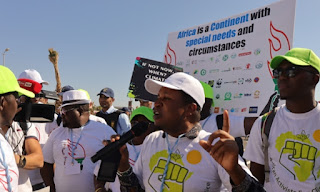
Kenyan experts from the civil society have joined their colleagues across the globe in challenging developed nations to wake up to the realities of climate change and ensure unity and trust in tackling the global phenomenon by allowing second committed of the Kyoto Protocol.

At the opening of the UN climate Change conference in Doha, Qatar on Monday , the experts joined their international colleagues from NGOs organized in the Climate Action Network (CAN) in accusing the industrialized countries among them US of being insensitive to the needs of millions of people facing the brunt of climate change.

They particularly criticized Japan and Canada for refusing to sign up to the Kyoto Protocol’s second commitment period.

Led by Dr. Bernard Okeyo, Executive director ECO –Ethic-Kenya, the environmentalists however called on US President Barack Obama and other world leaders believed to be ploting for death of  the Kyoto protocol to restart their international engagement in the interests of their citizens and millions of people around the globe.

They also called for countries both developed and least developing to make the ongoing Climate Change conference in Doha a success story in actions, ambition and equity, saying the Doha negotiations would present a turning point for the World in the war against Climate Change.

“Extreme effects of climate change have caught up with us, Cases of flooding, famine , droughts and diseases outbreaks have increased in every corner of our country, and something need to be done and done urgently to stop the mess” Said Okeyo.

Tasneem Essop, International Climate Policy Advocate for WWF specifically, called not only for developed countries to sign on to second commitment period of the world's only legally binding climate treaty, the Kyoto Protocol, but for the nations involved to increase their emission reductions within the treaty and to close the loopholes that existed within it which would let 30 billion tonnes of carbon escape into the atmosphere.

Ms Tasneem added that developed countries also needed to increase their emissions reductions commitments as current pledges were so far inadequate to keep the temperature rise below 2 degrees as well as to lock in finance to support mitigation action by developing nations.

“While developing countries can take on more action, they can only do so if developed countries meet their commitments to provide finance,” she said.

Speaking also after the opening of the Doha Talks, Martin Kaiser, head of the Greenpeace delegation, said the way countries approached the Kyoto Protocol would set the tone for the talks.

“EU leaders need to reject pressure from the coal and oil industry, and strengthen its legal limitation of atmospheric pollution without loopholes,” he said.

However United Nations Framework Convention on Climate Change UNFCCC Executive Secretary Christaina Figureas showed optimism in her opening speech where she asked the over 17, 000 delegates gathering for 18th session of conference of parties –COP18 at the Qatar International Conference Center in Doha to speed up the negotiations.

Spelling out the agenda of the COP18, the UNFCCC Chief said the Doha talks present a unique challenge to both the present and future under the Durban Platform for global response to climate change.

“The present way that ambition can be raised with necessary urgency and the future framework that will be applicable to all in a way that both ensure equity and response to the signs”

Abdullah Bin Hamad Al-Atttiyah currently the President of the 18th Session of Conference of Parties told participants at the opening that “climate change is a common challenge for humanity” and that the Conference was a “golden opportunity - we must make best use of it

Mr. Al-Attiyah who had earlier received strong criticism from across the global over fossil fuel production remarks emphasised Qatar’s continuing efforts as host country to foster an open, inclusive and transparent process.

The opening ceremony marked the official handover of the Presidency from South Africa to Qatar. Maite Nkoana-Mashabane, the COP17/CMP7 President, cited an African proverb highlighting the need for multilateral cooperation within the United Nations Framework Convention on Climate Change.

“If you want to walk fast, walk alone. If you want to walk far, walk with others,” she said before the official election of Mr. Al-Attiyah as President of COP18/CMP8.

The annual international Climate change Conference runs from 26th November to 9th December with 194 nations, Kenya included represented.

Wednesday, November 7, 2012

Obama's Re-election a Win for Climate Change Negotations .

As the world celebrates President Barack Obama's re-election to the White-house the question remains as to whether the current most powerful man in the World will keep to his recent promises of keeping United States of America accountable to climate change.

According to the Whitehouse , the President has taken unprecedented action to build the foundation for a clean energy economy, tackle the issue of climate change, and protecting environment..

Under the Obama administrations, the United States has engaged the international community to promote sustainable economic growth and to meet the climate change challenge through a number of important venues, including  being in the frontline in International Climate Negotiations.

For instance in December 2009, President Obama and other world leaders came together to negotiate the Copenhagen Accord, an important milestone in which, for the first time, all major developed and developing economies agreed to implement measures to limit their greenhouse gas emissions and to do so in an internationally transparent manner.

Then followed the Cancun Agreement in 2010 where the negotiations were confirmed and substantially extended the core elements of the Copenhagen Accord in the areas of finance, technology and adaptation as well as mitigation and transparency in an instrument that the Parties enthusiastically endorsed.

On greenhouse gas emissions, the Whitehouse confirms that the Obama administration was  pursuing a wide range of initiatives that reduce emissions through clean energy technologies and policies. Since 2008 , the Administration has made the largest clean energy investment in American history .

US has been among developed nations accused of being responsible for a large scale greenhouse gas emissions.

With the re-election of President Obama , the world will be waiting for his administration to soften its stands on international agreements such as the Kyoto Protocol, an international agreement imposing limits on emissions of carbon dioxide and other green house gases scientists blame for rising world temperatures and , rising sea levels.

The agreement was negotiated in 2004 in Kyoto, Japan and rectified by 140 nations , Kenya included. US has for many years failed to rectify the much negotiated agreement.

The agreement will feature among issues to be laid down on the table for discussions during forth-coming United Nations led Climate Change talks in Doha , Qatar later this month.

The Doha Climate Change-2012 is set to be held between 26th November and 9th December 2012.Over 17, 000 negotiators among them top government officials and scientists from across the world have been invited for the annual talks..


,

Tuesday, November 6, 2012

Kenya Plans To Expand Geothermal Energy


By  Diana Wanyonyi

Power blackouts experienced in various parts of Kenya in the past few weeks have posed a major challenge to the entire economy of the country especially the industry and business sector that bared the heavy cost during the incidences. 
 
To avert such situations in future, Kenya Government through the Kenya Electricity Generation Company-KENGEN is embarking on plans to invest heavily on electricity generation in the country.

These plans are focused on expanding geothermal energy production projects in the country specifically for sufficient and reliable supply of electricity.

Olkaria II Geothermal Power plant located in the Kenyan Rift Valley is one of those clean energy projects in the country, with a potential electric capacity of greater 105 MW. The plant has a total of 25 production wells that produce hot steam from the earth’s internal heat and three generating units. Each generating unit has capacity generating 35 MW.

Olkaria I Power Station is the first and the oldest plant in Africa, with electric capacity of 45 MW plant with three units each generating 15MW of electricity. The turbine is a thermo dynamic device that has several stages known as Impulse/ Reaction 6 – stage-condensing turbine.

The turbine run with an inlet hot steam pressure tapped from the underground magma of 4.8 bars at temperatures of 150 degrees Celsius.

According to a senior technician who requested to remain anonymous, they have already commenced on putting up a new power plant known as Olkaria IV, which will be bigger than Olkaria II Geothermal Power plant under KenGen.

“At the moment we are starting on another project called Olkaria IV Geothermal project, we are expanding first at this part of the Rift Valley called Olkaria then we will start to moving to other fields”. He said.

The new project when complete is expected to supply enough electricity to the country thus being alternative and relieve to many people who depends on power generated from hydro electricity during dry periods that are still experienced in some parts of the country blamed on climate change.

The technician says the geothermal is a clean energy, “ With the growing technology that we have in the world and also the ever growing population, we have so many problems that may come if we’d have projects which are not friendly to the environment. So the geothermal is a clean energy and being a clean energy it is therefore, widely accepted by the environment and also it is not harmful to the population around”.

Geothermal energy is the oldest renewable energy in the world that was used for various purposes such as cooking and heating. It is among energy sources that are less harmful to the environment hence contributing less to the climate change and global warming.

The energy expert explains that when steam is brought up from underground, small quantities of other gases are released into the atmosphere.

“We release Carbon dioxide (C02), Hydrogen Sulfide gas (smells like rotten eggs), Ammonia gas and we also release Methane gas. Among these gases we have the gases which contribute to climate change and global warming but by using the clean energy development mechanism we employ the processes which make sure that whatever we release to the environment is very low to a point where it won’t be able to contribute so heavily to global warming.” He uttered.

“Some of the excess gases we release them back to the underground where they pose no harm to the environment”, He finally said.

He said that there is need to sensitize the public on the need of the geothermal to avoid the criticisms that it is harmful to the environment and to human beings.

There is need for more investment in power sources like geothermal, as it is climate smart and always reliable.


Monday, June 11, 2012

Marine Expert Sounds Alarm over Massive Destruction of Kenya's Mangrove Forests.

By Charles Ogallo

A recent report released by Kenya Marine and Fisheries Research Institute-KEMFRI , the Kenya’s only  research institution dealing with marine and fisheries has revealed a massive deforestation of mangrove leaving the country with a loss of over 20 percent of her mangrove forest cover annually.

Most affected areas are Tudor Creek and Portreitz in Mombasa which lost 86 and 46 percent of their mangrove covers respectively, representing the highest mangrove loss rate not only in Kenya but globally.

In his speech during celebrations to mark this year’s World Biodiversity Day Dr. Jared Bosire the KEMFRI Deputy director admitted  that mangroves in these areas have been devastated and that causing serious environmental and socio-economic implications to marine ecosystem along the Kenyan Coast.

“Urgent concerted efforts are required to save these unique mangroves before they are completely devastated and thus save our biodiversity and livelihoods which depend on these mangroves” Dr. Bossire said.

The destructions are caused by people allegedly hiding in the forest to make illegal brews. Much of the trees are claimed to have been burnt and used as firewood by alcohol brewers who are hiding from police and other law enforcers. 

According to researchers, mangroves forests form part of nutrient-rich environments which promote a variety of food chains, hence function as nursery and feeding grounds for fish and invertebrates. Many of these species are known to spend part of their life cycle in coral reefs, sea grasses and open waters.

Historically, Mangrove trees have been important in shoreline stabilization and provide resources for both rural and urban coastal populations. It’s estimated that 70 percent of the wood requirement adjacent to mangroves come from this forest.

Dr. Bossire termed mangrove forests as important element in Climate change mitigation as well as in carbon trade investment globally. 

“In the context of climate change, mangroves are great carbon sinks, sequestering about 5 times more carbon per unit area than any other forest ecosystem thus helping in mitigating climate change. The sequestered carbon can infact be packaged and sold into existing and emerging international carbon market and that the funds from carbon units used to support mangrove conservation” he added.

The destruction of mangroves has therefore left the area prone to effects of climate change such as beach erosion and uncurbed carbon emissions.

Environmentalists are however calling for quick intervention from the government to avert the denting situation. They have also proposed for civic education on environmental conservation among residents to avoid a repeat of such occurrences.

Wednesday, April 18, 2012

CDM Proving to be a Powerful Mechanism for Sustainable Development Globally.

By Charles Ogallo

The Kyoto Protocol’s Clean Development Mechanism (CDM), the international market-based tool that incentivizes greenhouse gas emission reduction projects in developing countries, has registered its 4,000th project.

The wind power project in Maharashtra state, India becomes the 4000th CDM project to be registered by UNFCCC –CDM executive Board. The project is expected to reduce greenhouse gas emissions by 21,807 tonnes a year; the equivalent of removing the emissions from 4,275 cars each year.

“The CDM continues to evolve and improve, and deliver on a scale well beyond initial expectations,” said UNFCCC Executive Secretary Christiana Figueres. “Governments, the international Board that oversees the CDM and the UNFCCC secretariat have worked continually to simplify the mechanism, broaden its reach, safeguard its environmental integrity and prepare the CDM for the future.”

There are now CDM projects registered in some 74 countries worldwide, ranging from projects that reduce emissions by replacing inefficient wood stoves, to wind power projects that displace fossil fuels, to large industrial projects that destroy extremely potent greenhouse gases.

The number of CDM projects has risen briskly since the first project was registered in 2004. In 2011, 2,740 projects were registered, a 50 percent increase from 2010. In February 2012 alone, 256 CDM projects were registered, the second highest monthly number on record.


Projects registered under the CDM must produce real and transparent reductions in greenhouse gas emissions while contributing to sustainable development. Last December, when they met at the UN Climate Change Conference in South Africa, governments agreed a second commitment period for the Kyoto Protocol and confirmed a continuing key role for market-based approaches like the CDM.

“The agreement of a second commitment period for the Kyoto Protocol was vital in furthering international collaboration on climate change,” said Figueres. “Wherever the future climate talks lead, private sector engagement will be essential, and as such so will mechanisms like the CDM.”

At the behest of governments, a great deal has been done by the international Executive Board that oversees the CDM to safeguard its environmental integrity, streamline its processes, and extend its reach to under-represented countries and regions.

Among the improvements have been guidelines on setting broad, standardized emissions baselines against which projects can be judged and emission reductions assessed; procedures for programmes of activities that allow an unlimited number of projects over a wide area to be run under a single administrative umbrella; and guidelines on so-called suppressed demand, which allows projects in under-developed areas that do not have significant emissions to potentially qualify for registration.

“Much work has been done, especially in the past two years, to release the potential of the CDM,” said Maosheng Duan, Chair of the CDM Executive Board. “At 4,000 projects, the CDM has reached an important milestone. The threat posed by climate change requires that we continue, that we do much more and go much farther.”

To date, some 1500 projects in 47 countries have been issued a total of more than 900 million certified emission reduction credits. According to UNFCCC, The clean development mechanism (CDM) allows emission-reduction projects in developing countries to earn certified emission reductions (CERs), each equivalent to one tonne of CO2. CERs can be traded and sold, and used by industrialized countries to meet a part of their emission reduction targets under the Kyoto Protocol.

With 4,000 registered projects in 74 developing countries, the CDM has proven to be a powerful mechanism to deliver finance for emission-reduction projects and contribute to sustainable development.